Pregnancy Safe Collagen Powder: Is It Safe and What Should You Know Before Taking It?

The moment a woman finds out she’s pregnant, suddenly everything she touches gets a second look. Even the things that used to feel “totally normal” like collagen supplements turn into a big question mark. Is this safe? Can I take it while I’m pregnant? Or should I just leave it until after I give birth? With the term pregnancy safe collagen powder everywhere now, it’s completely normal to start searching and feeling a bit confused. Especially if you were already taking collagen before pregnancy for your hair, your skin, or even your joints.
What Is Collagen Anyway, and Why Do Pregnant Women Think About It?

Collagen is basically the main structural protein in the human body. If we imagine the body being built from bricks and cement, collagen would be a big part of the “cement” holding everything together. It’s found in the skin, hair, nails, ligaments, tendons, cartilage, and even the lining of the gut. The body naturally produces it, but over time and with physical stress that production can slow down.
During pregnancy especially, a woman’s body is working at full capacity. The skin stretches noticeably as the belly grows, weight increases, joints carry extra load, and hormones shift in ways that sometimes make your hair act differently after birth. By the fourth or fifth month, you might feel like your skin isn’t the same, your back hurts more easily, or your nails have become a bit weaker. These changes are completely normal, but they can make the idea of supporting your body with supplements like collagen pretty tempting.
That’s why terms like pregnancy safe collagen powder have started popping up more often, and many women are asking: is there actually a type of collagen that’s safe during pregnancy? And could it help me get through this phase a little more comfortably?
Let’s be realistic for a moment.
Pregnancy isn’t a disease, but it is a major physiological stress on the body. Anything that might ease that pressure naturally gets attention. As a supplement, collagen usually comes in a hydrolyzed form (peptides) that’s easier to absorb. The body then uses the amino acids in it for different building processes. But does that mean every pregnant woman needs it? Not really.
Many doctors believe that if your diet is balanced and you’re getting enough protein from food like meat, eggs, and legumes your body probably doesn’t need extra support. However, in certain cases, like poor appetite or joint discomfort, a supplement like collagen might be considered, as long as it’s pure and free from unnecessary additives.
Is There Really Something Called Pregnancy Safe Collagen Powder?
There’s no such thing as “100% safe for all pregnant women” when it comes to any supplement. Pregnancy is a very sensitive stage, and every body reacts differently. What works for one woman might not work for another. That said, some products can be closer to the idea of pregnancy safe collagen powder meaning a collagen supplement that’s carefully chosen, has clear ingredients, and doesn’t include anything questionable.
Pure collagen, especially when it’s just hydrolyzed collagen peptides, is generally considered low risk. Why? Because at the end of the day, it’s just broken-down protein turned into amino acids. The body handles it like any other protein source. It doesn’t contain hormones, stimulants, or complicated drug-like compounds.
But here’s the important part:
the issue is rarely the collagen itself. The real problem is usually the extras added to it. Things like:
- Artificial flavorings
- Artificial sweeteners
- “Hormone-supporting” herbs
- High doses of added vitamins
- Or even minerals that aren’t clearly listed
Sometimes you’ll see a product marketed as “for glowing skin” or “complete beauty support,” but when you check the label, it’s basically a full cocktail of unnecessary ingredients especially during pregnancy. That’s where the risk can be.
The real difference between a regular product and one that might be considered safer is simplicity. The shorter and clearer the ingredient list, the easier and usually safer the decision becomes.
Another thing many people overlook is the source of the collagen. Some are marine-based (from fish), others are bovine (from cows). If you have allergies to a certain source, that’s something you absolutely need to pay attention to. And it’s also important that the product is tested for purity. Heavy metals are not something to ignore, especially during pregnancy.
Read also: Collagen Peptides Pregnancy: Benefits, Safety & What
Is It Actually Beneficial During Pregnancy?
Up until now, there aren’t strong studies proving that collagen is essential during pregnancy. It’s not like folic acid or iron, for example nutrients that have a clear and proven role. So if you don’t take collagen, that doesn’t mean you’re neglecting yourself or your baby in any way.
But here’s where it gets a bit less black and white. Some women genuinely feel better when they use a collagen supplement that suits them, especially when it comes to things like:
- Skin elasticity as the belly stretches
- Joint and knee discomfort from weight gain
- Weak nails
- Or even just a general feeling of supporting the body
Is this a scientifically confirmed, pregnancy-specific effect?
No. But it makes sense that when the body gets extra amino acids, it may use them for repair and building processes.
Let me say something that might feel very real to you. It’s supporting you and building a whole new human at the same time. So some women feel like they need extra support. That’s why they start searching for the best collagen to take while pregnant not just for beauty reasons, but for comfort.
I remember a friend of mine who was in her fifth month. Her knees were really bothering her. She gained weight faster than expected, and the pressure on her joints made even simple movement tiring. Her doctor allowed her to take a small dose of pure collagen, with no added ingredients. After about three or four weeks, she told me, “The pain didn’t disappear but it’s lighter. I can move better now.”
Not a miracle.
Not a dramatic transformation.
Just a small, noticeable difference.
And that’s important to understand. Collagen isn’t a treatment. It’s not a guarantee against stretch marks. It’s not a magic fix for pregnancy changes. simply a supportive element that might help in some cases.
How to Choose the Best Collagen to Take While Pregnant?
If your doctor tells you there’s no problem taking it, then this is where the important part begins… choosing the right one. Not every jar that says “collagen” on it is suitable during pregnancy the packaging looks reassuring or attractive. Let’s go step by step, like we’re standing in a pharmacy looking at the shelf together.
1. Choose a Product with One Ingredient
If it’s long, honestly, just put it back. A product that could truly fit the idea of a pregnancy safe collagen powder will usually contain just one thing: collagen peptides. No:
- “Hormone-balancing” herbs
- High doses of biotin
- Mixed vitamin blends
- Vague, unclear additives
The simpler the formula, the calmer and safer the decision feels. Pregnancy isn’t the time to experiment with advanced beauty mixes.
2. Stay Away from Huge Doses
Some brands love big numbers.
10 grams… 20 grams… 30 grams per scoop!
But pregnancy isn’t a competition. Just because it’s protein doesn’t mean we increase the dose on our own.
Moderate amounts (based on your doctor’s advice) are more than enough. Your body won’t benefit just because the number is bigger. In fact, too much could make digestion harder or put extra strain on the kidneys for some people.
3. Make Sure It’s from a Trusted Source
Ask yourself:
- Does the product mention third-party testing?
- Is the source of collagen clear (bovine or marine)?
- Does it state that it’s tested for heavy metals?
These may seem like small details, but during pregnancy, small details matter a lot. It’s also better to choose something without artificial flavors or strong sweeteners. A neutral taste might not be the most exciting thing in the world, but sometimes it’s the safer option.
4. Ask Yourself One Very Important Question
Before buying any supplement, pause and think: Am I already getting enough protein from food?
Sometimes we rush to supplements when what we really need is to adjust our diet. If your meals already include eggs, meat, chicken, fish, legumes your body might not need extra support. In that case, searching for the best collagen to take while pregnant becomes more of a personal choice than a medical necessity.
5. Don’t Buy Out of Fear
This might be the most important point of all.
- Pregnancy can make us more anxious.
- We worry about stretch marks.
- About hair loss.
- About our body changing.
So we try to control whatever we can even if it’s just a simple supplement. Choose while you’re calm. Not while you’re scared.
So… Can It Cause Harm?
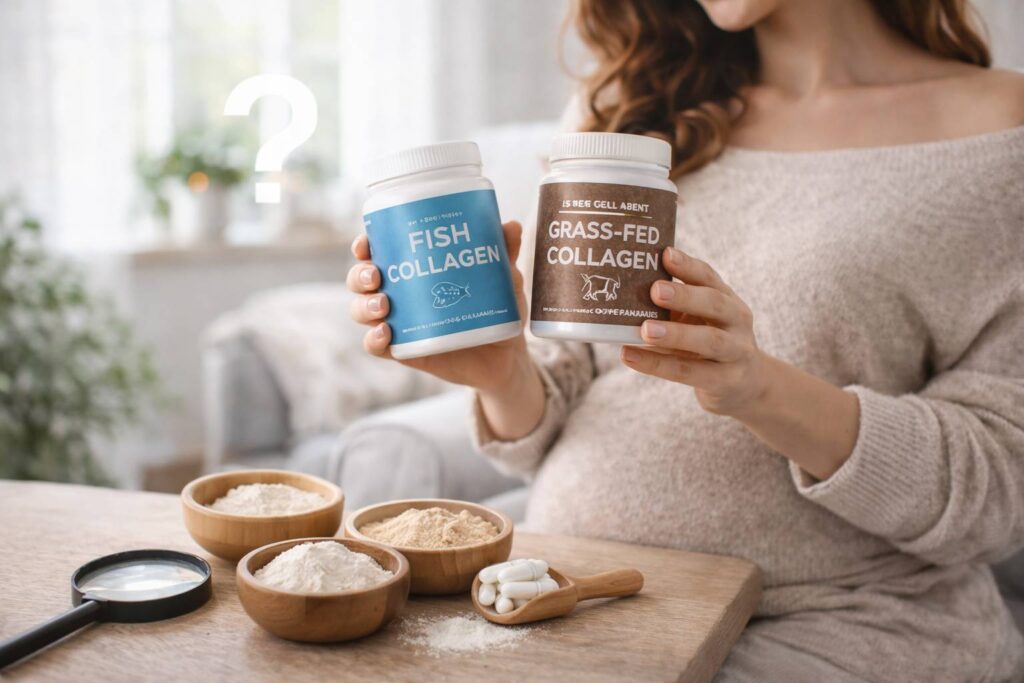
That’s a very reasonable question. Anything we put into our bodies during pregnancy deserves extra attention. So far, there’s no strong scientific evidence showing that pure collagen on its own directly harms pregnant women. At the end of the day, it’s just broken-down protein turned into amino acids, and the body treats it like any other protein source. That’s why some doctors may allow the use of a pregnancy safe collagen powder if your individual situation allows it. But and this part really matters the risk isn’t always in the collagen itself. The concern usually shows up in situations like these:
1. Unknown or Unreliable Sources
If the product doesn’t clearly state where it’s sourced from, or the company doesn’t mention quality testing, that’s a red flag. Not everything sold online goes through strict regulation, and a lot of people don’t really think about that.
2. Heavy Metal Contamination
Some supplements may contain trace amounts of heavy metals like lead or mercury if the manufacturing process isn’t clean. The amounts are often small, but during pregnancy, we’re not looking to take even small risks.
3. High Doses of Vitamin A
Some “complete beauty” supplements include it without people realizing. That alone is a good reason to read the ingredient list carefully line by line.
4. “All-in-One Beauty” Formulas with Too Many Ingredients
Products labeled “Hair, Skin & Nails Formula” that contain 10–15 different ingredients? Those are usually not ideal during pregnancy. Just because something is “natural” doesn’t automatically mean it’s safe for a pregnant woman especially when it comes to herbs or hormone-supporting blends.
There are also rare individual cases where someone might experience:
- Mild stomach upset
- Bloating
- A bit of digestive discomfort
- It’s not dangerous, but it can happen.
That’s why I always say: A clean formula matters more than the brand name. It doesn’t matter how pretty the packaging looks. What matters is what’s actually inside the container.
The Difference Between Collagen and Protein Powder During Pregnancy
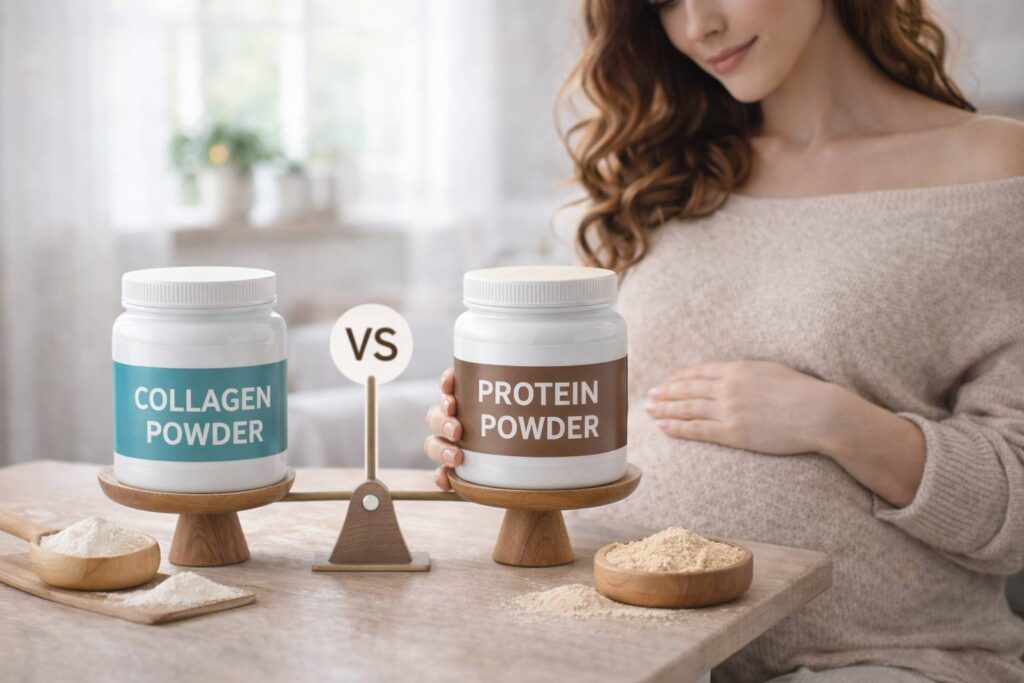
A lot of people think they’re basically the same thing. I mean, aren’t they both just “protein”? Yes, technically they are but the difference actually matters, especially during pregnancy.
Collagen is a type of protein, but it’s not a complete protein. What does that mean?
It means it doesn’t contain all the essential amino acids your body needs daily. It’s rich in certain amino acids like glycine and proline, which support skin and joints, but it’s missing other essential ones that your body can’t produce on its own.
On the other hand, proteins like whey (from milk) or complete plant-based protein powders contain a full range of essential amino acids. That’s what makes them more suitable for meeting your daily nutritional protein needs.
In simpler terms? Collagen is not a replacement for dietary protein. You can’t drink a pregnancy safe collagen powder and assume you’ve covered your protein intake for the day. If your diet is low in protein, the priority should always be improving your meals or choosing a complete protein supplement not collagen.
And here’s something important: during pregnancy, your protein needs increase. Your body needs it for fetal growth, placenta development, and increased blood volume. So if there’s a deficiency, it’s better to address it with a complete protein source rather than something mainly marketed for beauty support.
If you’re still unsure about protein supplements in general during pregnancy especially the difference between safe and unsafe options I’d honestly recommend reading this article: How to Choose a Pregnancy Safe Protein Powder Without Risks
Does Collagen Prevent Stretch Marks?
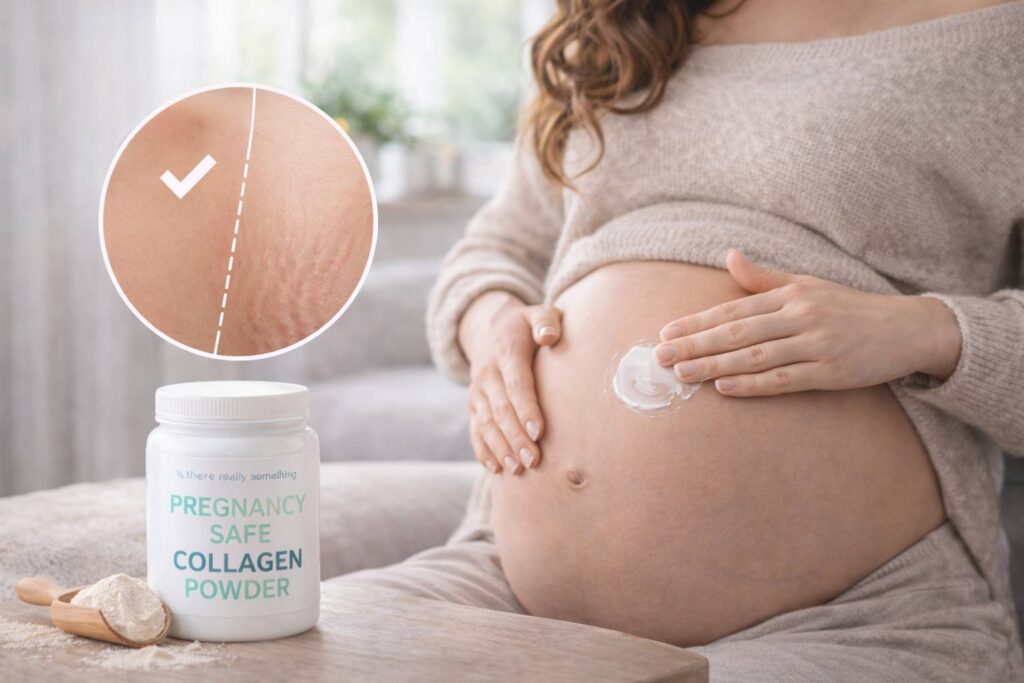
this question almost every pregnant woman thinks about she doesn’t say it out loud. Stretch marks can honestly feel scary. You might find yourself standing in front of the mirror, looking at your belly, and wondering, “Is there anything I can do to reduce this?”
Let me be clear: there’s no magic supplement that prevents stretch marks. It’s more complicated than just adding a scoop of collagen to a glass of water.
Stretch marks happen because the skin stretches quickly, combined with hormonal changes. And they depend on several factors, especially:
- Genetics (if your mom or sister had them, the chances are higher)
- How quickly you gain weight
- Your natural skin elasticity
- Your internal and external hydration levels
Collagen may support skin elasticity because it provides amino acids your body uses to build tissues. But does that mean it will prevent stretch marks? No. It’s not a guarantee. It’s not protective armor.
In reality, some women take the best collagen to take while pregnant and still develop stretch marks. Others don’t take any supplements and barely get any. That alone shows how big a role genetics really plays probably more than we like to admit.
What can realistically help to some extent?
- Gradual, steady weight gain
- Drinking enough water
- Moisturizing the skin daily with suitable oils or creams
- A balanced diet with enough vitamin C and protein
But even with all that, stretch marks can still appear. And that’s completely normal. So if someone is selling you collagen as the “ultimate solution” for stretch marks, take that claim with caution. Pregnancy isn’t a battle against your body. It’s a phase where your body changes a little because it’s doing something incredible.
And yes if stretch marks show up, they’re part of the story. Not a flaw. Not a failure. And definitely not proof that you didn’t take care of yourself.
Read also: Best Vegan Prenatal Vitamins: A Complete Guide for a Healthy Pregnancy
When Should You Completely Avoid Collagen?
Sometimes, the safest choice is simply not to take collagen at all the product is marketed as a pregnancy safe collagen powder or labeled as “perfect for pregnancy.” Just because something is allowed doesn’t mean it’s right for you personally. Here are situations where it’s better to stay away:
1. If You Have Kidney Issues
Collagen is still protein at the end of the day. And increasing protein intake can put extra strain on the kidneys. If you have a history of kidney problems, or your lab results aren’t stable, protein supplements in general not just collagen need serious caution. In that case, your priority is keeping your health stable, not adding any beauty-related supplement.
2. If You’re Allergic to Its Source
Some collagen is marine-based (from fish), and some is bovine (from cows). If you have a known fish allergy, marine collagen isn’t safe for you someone says it’s the “purest” type. Same idea with bovine sources if you’re sensitive to them. A lot of people overlook this and assume that “collagen” as a word is enough. It’s not. The source really matters.
3. If Your Doctor Clearly Says No
Sometimes we secretly hope the doctor will change their mind or we try to convince ourselves that “it’s just a small dose.” But if your doctor says no based on your health condition, it’s best to listen.
They see the full picture your labs, blood pressure, medical history. In certain cases like pregnancy-related high blood pressure, gestational diabetes, or serious digestive issues, they may prefer avoiding any unnecessary supplements.
4. If You’re Taking It Out of Anxiety, Not Need
This one is more personal. If the real reason you’re searching for the best collagen to take while pregnant is fear fear of stretch marks, fear of how your body will look after birth maybe it’s worth pausing for a moment.
Not every change during pregnancy needs fixing. And yes sometimes the answer is simply: “Wait until after delivery.”
That’s not a bad decision at all. In fact, it can be the more comfortable one. After birth, your body starts to settle, your options are wider, and the risks are lower. Pregnancy is temporary. You don’t have to solve everything right now. Sometimes, postponing is the smartest choice.
Conclusion
A pregnancy safe collagen powder isn’t a myth but it’s not a necessity either. If the product is pure, free from additives, and your doctor is okay with it, it’s generally considered safe in moderate amounts. But if you’re unsure, or you don’t truly need it, there’s no reason to pressure yourself. Pregnancy is a sensitive time. You don’t have to try everything just to be a “perfect” mom. Sometimes, the simplest choice is the best one.
Read also: Foods to Avoid During Pregnancy: What You Must Skip for a Safe Pregnancy
FAQs
In some cases, yes if the product is pure and your doctor approves it. It’s not necessary for every pregnant woman, and the decision really depends on your individual health situation.
The safest option is a pregnancy safe collagen powder that contains only collagen peptides no added herbs, extra vitamins, or artificial flavors.
Sometimes yes, in moderate amounts and after checking with your doctor. But if your diet is balanced and there’s no clear need, it’s not a must.
During the first trimester, it’s usually better to avoid any non-essential supplements. If your doctor agrees, choose a very simple collagen product with no added ingredients.
Medical Disclaimer: Since nutritional needs vary from person to person based on health status, age, and medical history, we strongly recommend consulting your physician or a certified nutritionist before starting any new diet or changing your eating habits, especially if you have chronic conditions or are taking specific medications. Accordingly, the nutritional information provided in this article is for educational and informational purposes only and should not be considered medical advice or a formal diagnosis.